
Beyond Chatbots: What AI Agents Actually Change in Enterprise Software

Beyond Chatbots
What AI Agents Actually Change in Enterprise Software
Most enterprise AI projects start with a chat window. The ones that pay off rarely end there.
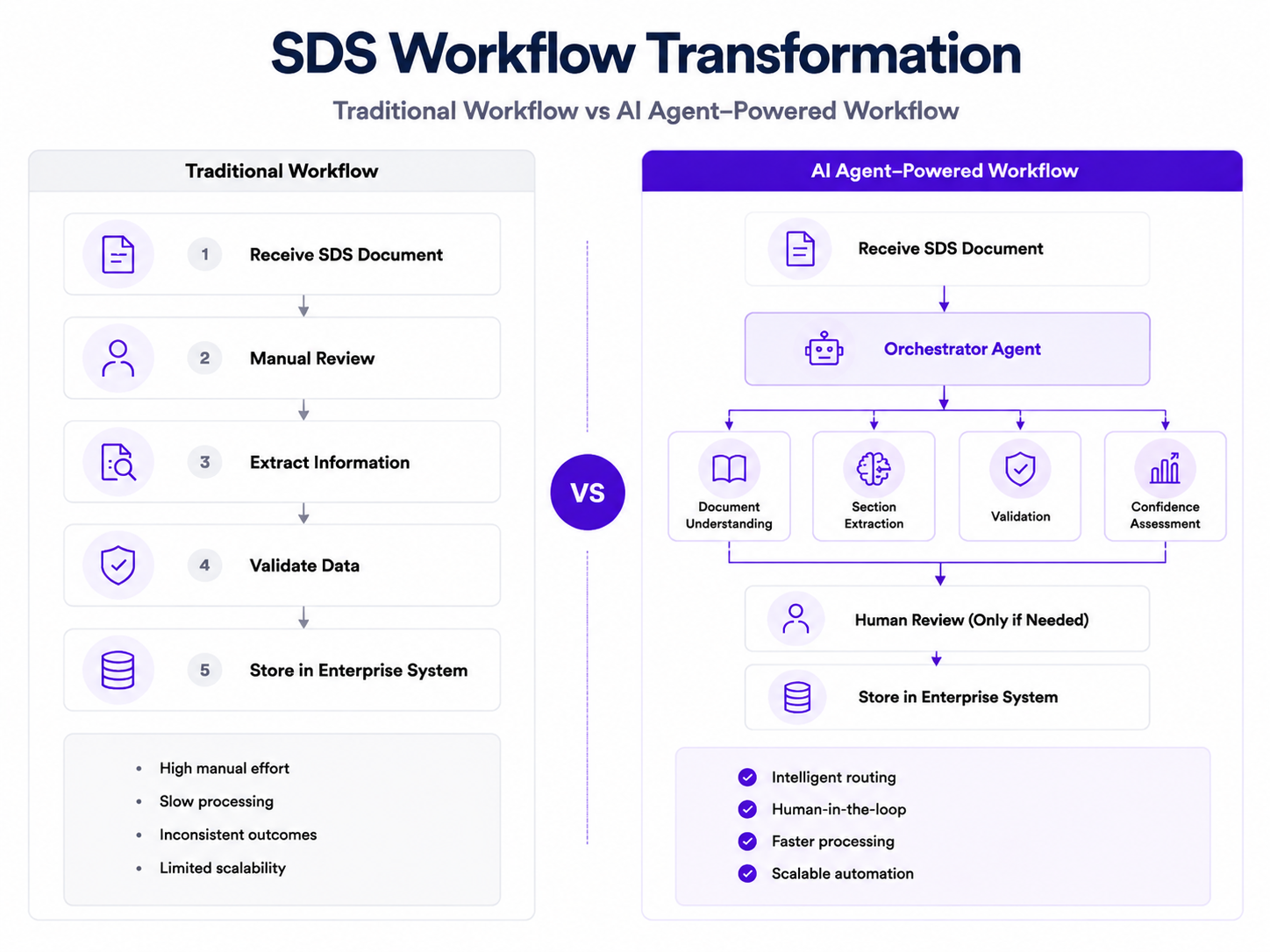
Traditional workflow vs AI agent-powered workflow
For decades enterprise software has worked the same way. You open a screen, search for a record, fill in some fields, press save, and move on. The CRM works like that, and so does the internal tool somebody in finance built back in 2014. The person does the thinking and the clicking, while the software simply keeps the record.
Generative AI put a chat box on top, and for a while that felt like progress. The trouble is that an answer is rarely the whole job. Someone still has to open the right system, check the rules, deal with the odd case, and decide whether a manager should look. A chatbot will happily describe those steps. It won't do any of them.
AI agents are built to do them. In this post, we'll cover how an agent differs from a chatbot, what goes into one that survives production, and when to use several. Our running example is Safety Data Sheet processing, because it's messy and it's one we know well.
A Short History of Who Does the Work
Desktop software puts paper forms on a screen. The web connected people and data across offices. Cloud and SaaS made software easier to access, scale and maintain. With each shift, software took on more of the work, while people spent less time managing the system itself.
Generative AI changed how we interact with software, letting people use plain language instead of navigating screens and forms. AI agents take that one step further: they can reason, plan, and execute workflows with human oversight.
The shift is no longer just about making software easier to use. It is about changing who does the work. The next generation of enterprise software won't just help people complete a workflow. It will take responsibility for completing more of it.
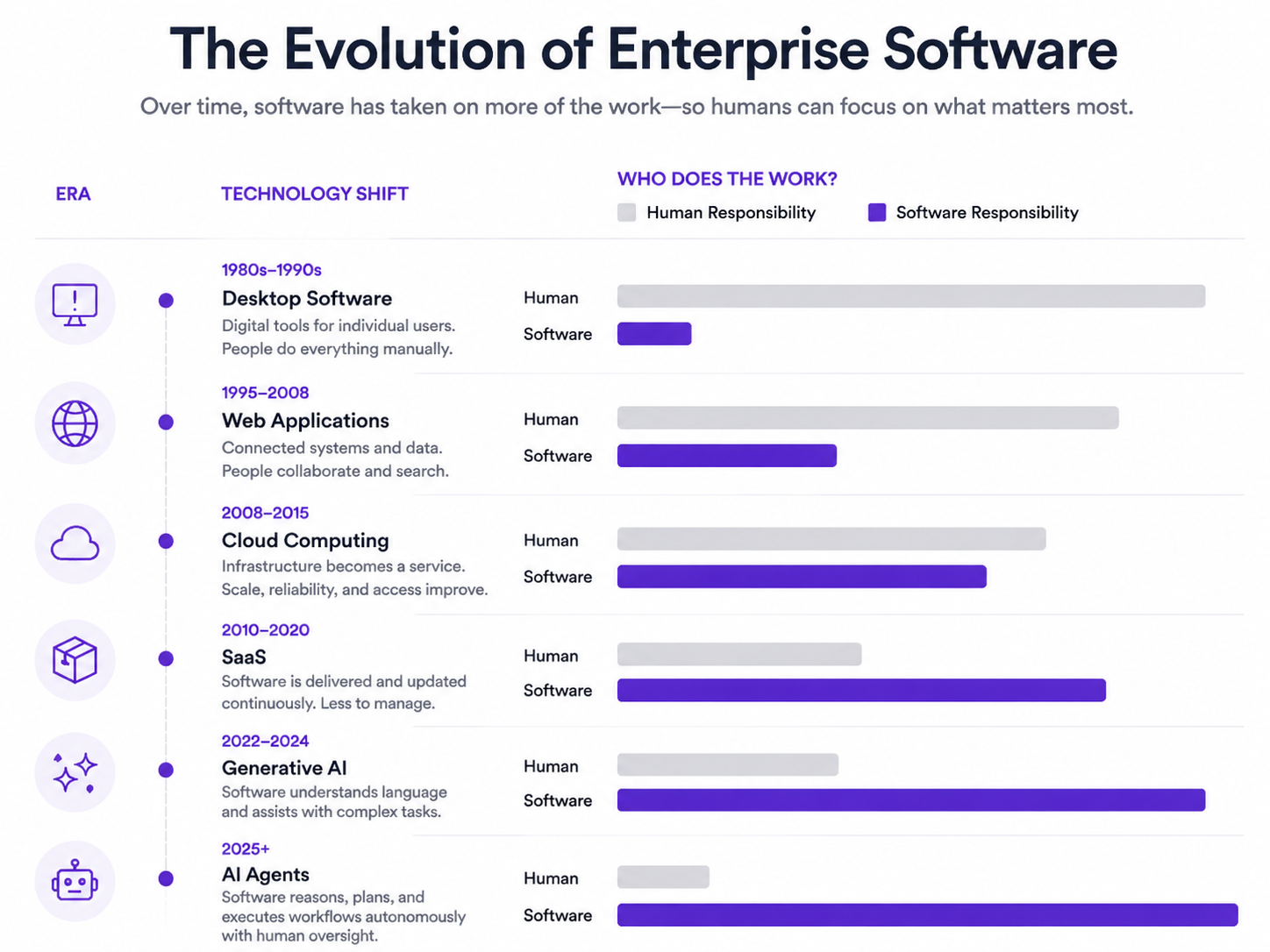
Over time, software has taken on more of the work, so humans can focus on what matters most
Chatbot vs AI Agent
A chatbot and an agent can run on the same language model. The difference is what they're built to do with it.
A chatbot is built around a turn of conversation with a step where: you ask, it answers; it waits.
An agent is built around a goal. It splits the goal into steps, fetches context, calls tools, copes with surprises and knows when to ask a person. Hand a chatbot a Safety Data Sheet, and it'll tell you what it says. Hand it to an agent and it will check if the file really is an SDS, pull out the sections you need, test them against your rules and send anything doubtful to a specialist.
That sounds like a small difference, but it changes how you build, test and monitor the thing, and how far you trust it, because it's changing records in live systems.
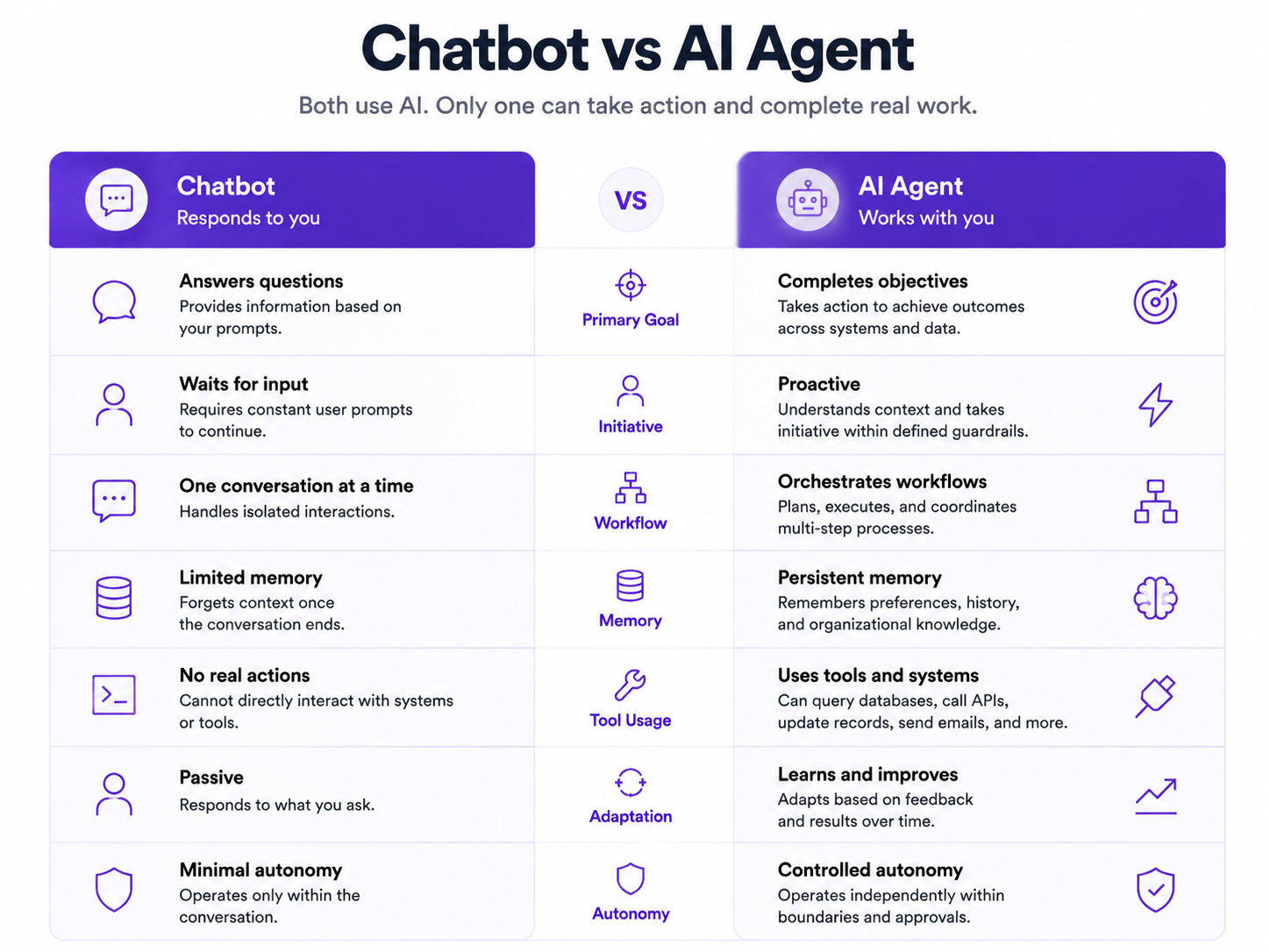
Both use AI. Only one can take action and complete real work
What Goes into a Production Agent
People assume an agent is a chatbot with a bigger model. It's closer to a small software system with a model in the middle, and in production we keep finding the same five parts.
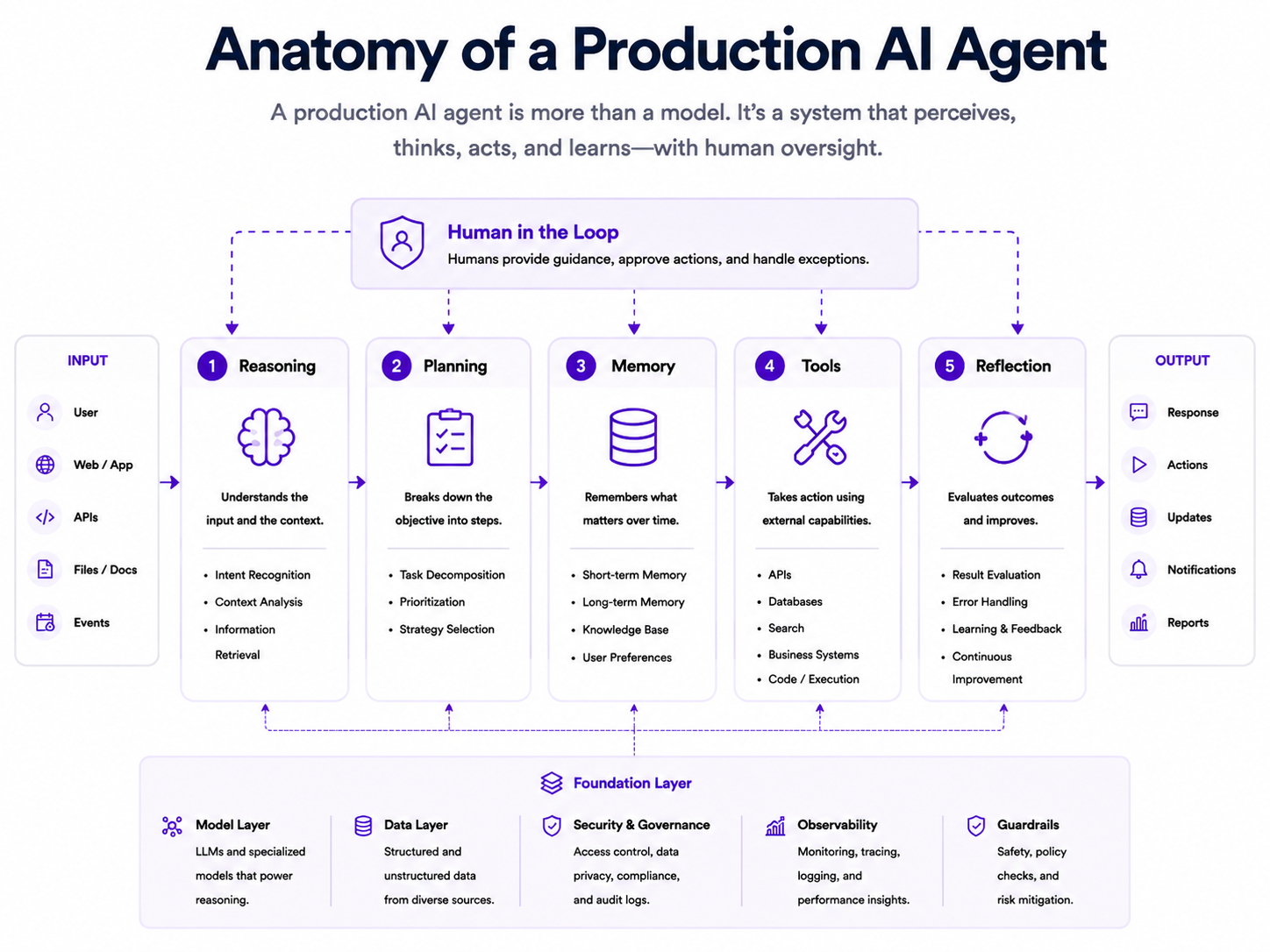
A production AI agent is more than a model — it's a system that perceives, thinks, acts and learns, with human oversight
Reasoning
The agent looks before it acts. If an SDS gives a flash point of 23°C on page two and 93°F on page five, those don't match, and copying both into the database is the wrong move. The agent should settle it from the rest of the document or pass it to someone who can.
Planning
The agent turns a goal into ordered steps: confirm the document type, detect the layout, pick an extraction approach, validate, score confidence and escalate only what needs it. The user says what they want. How to get there is the agent's problem.
Memory
Memory stops every job starting from zero. If a reviewer has fixed the same supplier density field three times, the fourth document from that supplier shouldn't need fixing. Without memory, it will.
Tools
Tools are how the agent reaches your systems: reading PDFs, querying databases, updating ERP records, and raising tickets. Take them away and you're back to a chatbot that can only describe the work.
Reflection
Before calling a job done, the agent checks for missing fields, contradictions and low confidence. A lot of reliability comes from treating the first pass as a draft.
Around all five sits human oversight: clear rules for when the agent carries on alone, when it validates and when a person must approve. In our experience those rules decide success in production more often than the choice of model does.
One Agent or Several?
Start with one. If the workflow is short, the tool list is small, and you can say what a good result looks like, a single agent is easier to build, watch, and fix.
Several agents pay off when the work runs through multiple stages or approval steps. One enormous prompt handling everything gets hard to test and harder to change. Split it into document understanding, extraction and validation, with a workflow coordinating the steps. When extraction quality drops after a change, you know where to look.
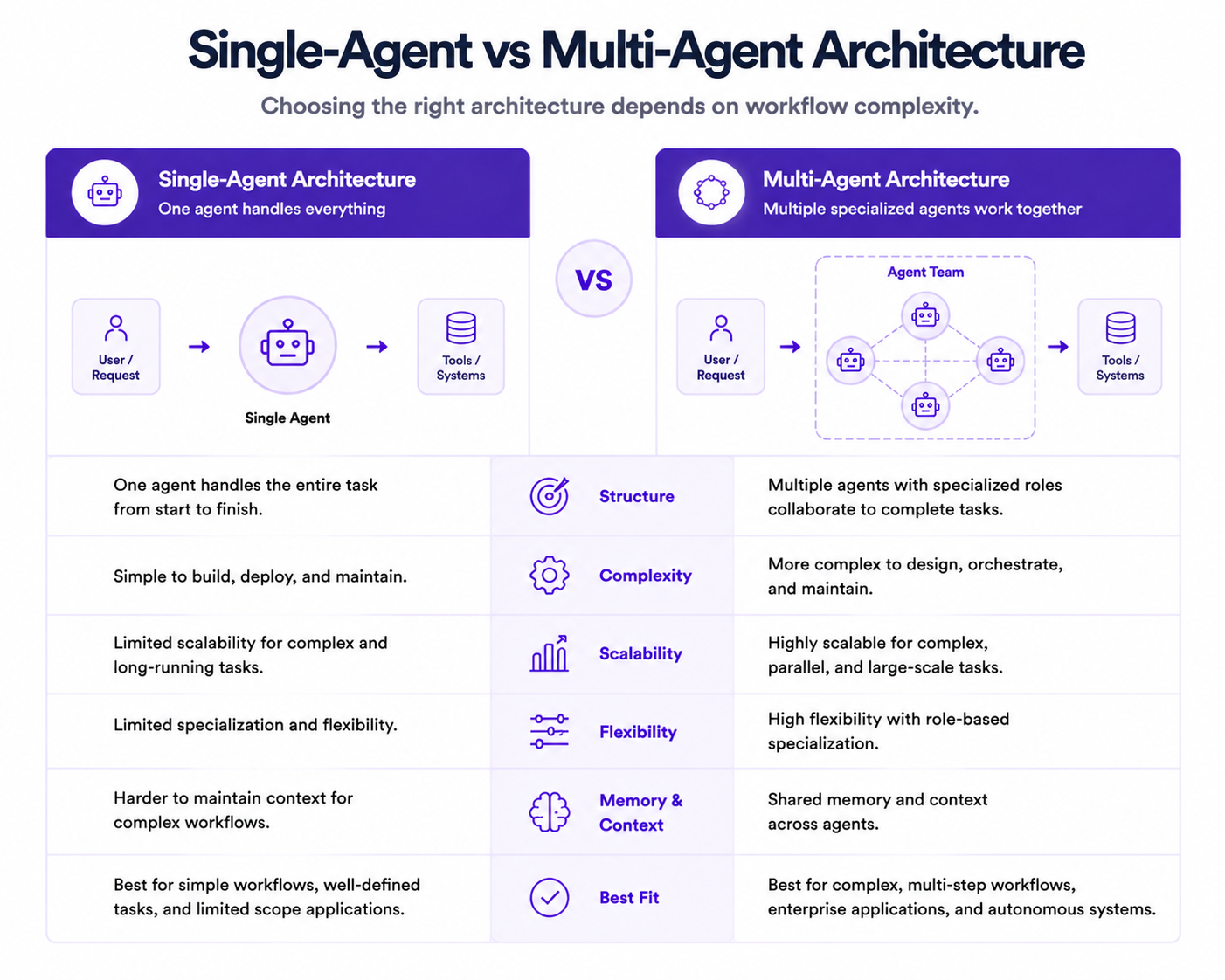
Choosing the right architecture depends on workflow complexity
Just don't add agents because the architecture diagram looks impressive. Each one brings another prompt to maintain, more hand-offs that can fail, and more cost per document. Add an agent only when you can measure what it buys you.
Control, Audit Trails and the Business Case
Nobody sensible wants an agent with unlimited freedom inside their ERP. Routine, low-risk work where the agent is confident can run automatically. Uncertain work goes to review. Big decisions stay with named people, whatever the confidence score says.
That only works if governance and observability are built in from day one. When an auditor asks, you need to show which systems the agent touched, which rules it applied, why it decided what it did and who signed off. An agent you can't audit shouldn't be in production.
This is where the return shows up: less manual handling, more consistent output, shorter cycles, and more volume without hiring in proportion. What people usually notice first is specialists no longer spending their mornings on copy-and-paste. And none of it replaces your ERP or CRM. The agent works through them.
Where This Leaves Us
Chatbots gave enterprise software a friendlier front door. Agents change who does the work behind it.
So, treat it as an engineering project and resist turning it into a model-shopping exercise. Design the workflow first, decide how much autonomy each step gets, measure the results, and widen that autonomy as the system earns it. The experts stay. They just spend their judgment on the cases that need it.
Start with a focused, high-impact scope
Deliver more with fewer
people.
Bring us a data operations bottleneck, a delivery capability gap, or a GCC ramp challenge. We'll recommend the right team shape and operating model and prove it with a real working engagement.