
AI Agents Don’t Just Need Better Scores. They Need Better Explanations!

PERSPECTIVE · ENGINEERING LEADERSHIP
AI Agents Don’t Just Need Better Scores
They Need Better Explanations!
In my last reflection on AI agents, I wrote about how much they have taught me about communication.
Not because they always get everything right. They do not. But because, at their best, they make a useful habit visible: they show the path, not just the destination.
They clarify the goal. They state assumptions. They check what they know. They adjust when new information arrives. And in doing that, they remind us of something very human: trust is easier to build when people can see how a conclusion was reached.
That lesson becomes even more important when we move from using AI agents to building and shipping them.
Why AI Agents Change the Meaning of Readiness
Because in the world of agents, communication is no longer just a soft skill. It is becoming part of how we prove that a system is ready.
The Checkmark vs. the Claim
For most software history, readiness was easier to signal.
Tests passed. The pipelines went green. Dashboards showed success. When someone asked, “Is it ready?”, the system often gave us a clean answer.
The checkmark did the arguing.
Why a 96% Eval Score Isn’t Enough
Agents change that.
They still need to be tested, of course. But the meaning of the test result is different. A passing unit test says something fairly direct: this expected behavior occurred. An eval score says something more complicated: under these conditions, on these examples, judged in this way, the system performed at this level.
That is not a checkmark.
That is a claim.
And like any serious claim, it needs context.
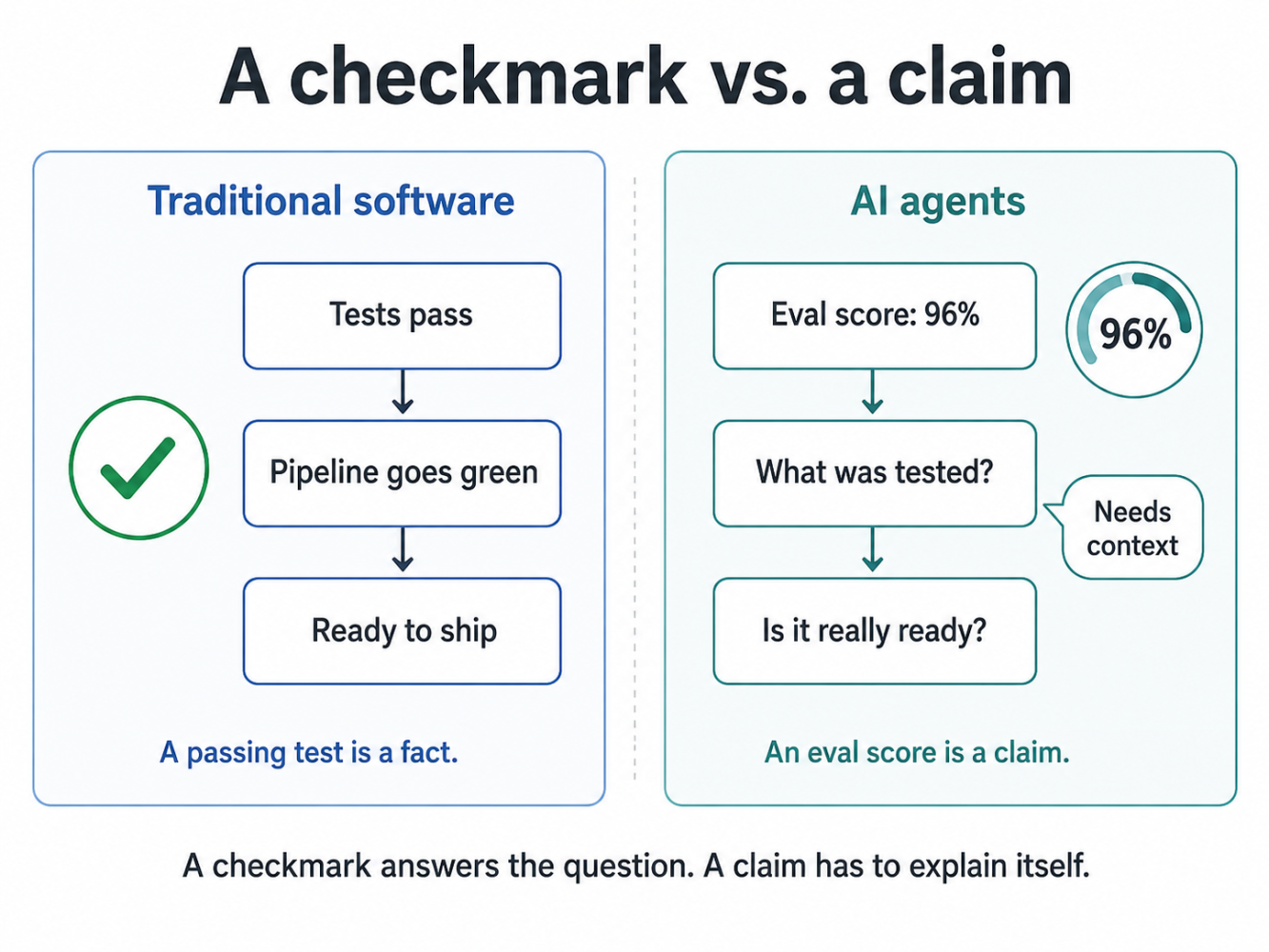
A checkmark vs a claim
Imagine an agent that matches incoming invoices to purchase orders. An invoice arrives, the agent reads it, finds the PO it believes the invoice belongs to, compares the details, and flags anything that does not reconcile.
Now imagine the eval score is 96%.
That sounds strong. In a review meeting, it would be easy to feel reassured by that number. It feels objective. It feels precise. It feels like the system has been tested.
But the real question is not whether 96% is a good score.
The real question is: 96% of what?
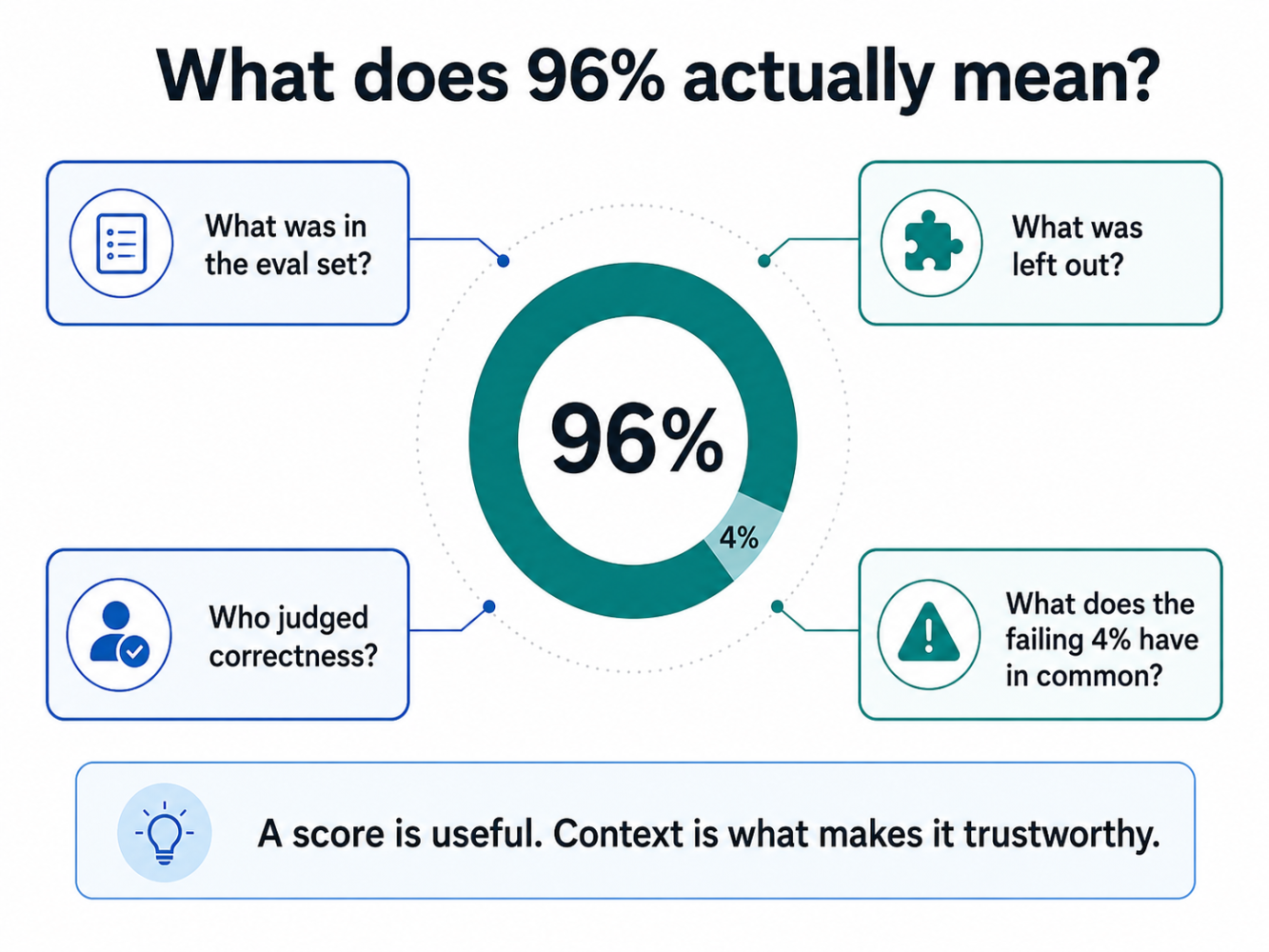
What does the failing 4% mean?
The Risk Hidden Inside the Failing 4%
What was inside the eval set? Were the examples realistic? Did they include messy cases? Did they include the vendors that matter most? Who judged the answers? What kinds of mistakes were counted as failures?
And most importantly: what does the failing 4% have in common?
That is often where the real risk lives.
In the invoice example, the failures may not be random. They may cluster around vendors with multiple open purchase orders at the same time. Maybe those invoices look almost identical. Maybe the agent confidently picks the wrong PO when two candidates are very close. Maybe those same vendors are high-volume accounts, which means the failures are not just edge cases. They are expensive cases.
The score did not lie. It was just incomplete.
This is the danger of treating eval scores like checkmarks. A number can create confidence before it creates understanding.
From Scores to Explanations
And that is why communication matters so much.
Not communication as decoration. Not communication as presentation polish. Communication as the ability to make evidence, uncertainty, and risk visible enough for others to trust a decision.
What a Trustworthy Eval Conversation Looks Like
A team should not only be able to say, “The agent scored 96%.”
It should be able to say:
“We tested it against these kinds of cases. It performs well here. It struggles here. We found that failures were concentrated in this pattern. We changed the system so that when two matches are too close, it escalates instead of guessing. We added those cases back into the eval. This is what improved, and this is the risk that remains.”
That is a very different conversation.
It is also a much more trustworthy one.
When Engineering and Communication Meet
The future of AI work will not reward only the teams with the best demos. Demos show what an agent can do when things go right. Evals show how it performs under defined conditions. But evals, explained honestly, show whether the system deserves trust.
This is where engineering and communication start to meet.
A capable system can stall because no one can explain why it is safe. A weaker system can ship because a high score was presented with too much confidence and too little context. Both are failures of communication.
The skill is not to oversell. It is not to hide uncertainty. It is to claim exactly what the evidence supports, no more and no less.
What “Ready” Really Means for AI Agents
That may feel unfamiliar, especially for people used to letting the green checkmark speak for them. But agents ask for a different kind of discipline.
- They ask us to define what “ready” really means.
- They ask us to look closely at failure, not just success.
- They ask us to treat every production miss as a missing eval.
- And they ask us to explain our reasoning clearly enough that others can follow, challenge, and trust it.
From Checkmarks to Trustworthy Claims
That last part may be the real shift.
As agents become more capable, the human skill around them becomes more important, not less. Someone still has to ask better questions. Someone still has to understand the shape of the risk. Someone still has to turn a score into a responsible decision.
The old world of software gave us checkmarks.
The new world of agents asks us to make claims.
And the teams that earn trust will be the ones that can stand behind those claims with clear evidence, honest context, and communication that helps the room understand not just the answer, but the path that led there.
Table of Contents
- Why AI Agents Change the Meaning of Readiness
- The Checkmark vs. the Claim
- Why a 96% Eval Score Isn’t Enough
- The Risk Hidden Inside the Failing 4%
- From Scores to Explanations
- What a Trustworthy Eval Conversation Looks Like
- When Engineering and Communication Meet
- What “Ready” Really Means for AI Agents
- From Checkmarks to Trustworthy Claims
Start with a focused, high-impact scope
Deliver more with fewer
people.
Bring us a data operations bottleneck, a delivery capability gap, or a GCC ramp challenge. We'll recommend the right team shape and operating model and prove it with a real working engagement.